


I’m obsessed with the craft of writing. I write every day, I read about the craft often, and in my spare time I like to unwind by… watching interviews where authors talk about their writing process. It’s a sickness. Help me.
One of the key things I’ve learned is this: there’s no real blueprint. I say this to aspiring writers in my workshops, and those I mentor. There’s no one way – every writer will have a different path to creation. Now, this doesn’t mean you shouldn’t be listening to other authors, not at all – it’s a great way to help you think about the creative process – but it does mean nothing is holy writ.
Except the one golden rule*. One rule that is true, no matter the writer. One rule, that if you don’t follow, means you shouldn’t be writing in the first place.
Here it is: Read as much as you can. Read widely and well.
I would’ve thought the necessity of reading in this profession obvious. But I’ve noticed a worrying trend lately: aspiring writers who don’t read.
Whenever I give a workshop, or an occasional creative writing lecture at uni, or mentor an individual, I always ask the following questions: who are your favourite authors? And, what are you reading now? I do this as a short cut to finding out their interests, and how therefore I might frame my advice.
But over the past few years, more and more the answer will be: I’m too busy to read. Or: I haven’t read a book in a while (whereafter they rack their brains and tell me they might’ve read Fourth Wing a year back).
To which I say this: fuck you, you’re not too busy.
Joking. I would never say that. But I certainly fucking think it. Now, to be clear – I’m not dissing the Fourth Wing here. On the contrary: if Fourth Wing is a gateway drug to getting someone back into reading, then anyone who loves books should be thankful to Rebecca Yarros.

But I am saying this: go look at your phone, and tell me what your average screen time is per day. Two hours? Five? Seven? If so – shut up: you’ve time to read.
I write full-time, currently work three gig jobs on the side, and am engaged with lives of my two children. I read every night. It’s not hard: instead of staring at my phone, or streaming, I read. This is not a boast, nor is it special. This is my job as a writer.
You want to be a writer? Then shut up and read.
Here’s why:
1) Reading teaches the writer about the craft
Every book is an education. Good, bad, mediocre, they teach us the writing craft. Even if we’re not studying the text per se, we’re learning. All the books you’ve ever read – especially the books you read when you were younger – have imprinted themselves on your brain.
It might be genre, character type, trope, setting, structure, anything, everything – you’ve habituated your brain to the patterns and elements of the novel. Certain writers will have a style that will appeal, and it is completely fine to emulate that style as you develop your own ‘voice’ as a writer (by voice I mean, the expression of individuality in your art).
When I began writing, I had some early beta readers say: oh, I see you’ve followed the classic three-act structure. To which I thought: I did? I didn’t know structure back then; I’d never taken a creative writing class. Yet my writing brain instinctively created one, because it had been informed by my life as a reader.
In the years since, I’ve subsequently taught classes on three and five-act structures, and the purpose of structure in general. I’m not saying such formal classes are of no value, but I do tend to think they are overrated. The reality is, up until recent decades, ‘creative writing’ was not a degree in and of itself. The much-vaunted MFA is only a relatively recent phenomena. They might be useful for some, but ultimately are peripheral compared to the central importance of reading.
2) Reading inspires the writer
I love reading out of genre. The best ideas I get for science fiction don’t come from science fiction. Crime, for example – hardboiled fiction in particular – helped me better understand the origins of cyberpunk, its thematic core, and some of the stylistic possibilities of the subgenre. Non-fiction has given me an unending supply of the raw materials for story – whether that be current events, or history, or science, or philosophy, or anything else – and been a constant source of inspiration. Poetry, as a third example, has taught me how I might use words in an elegant way, and with the strictest of economy create an image, or a mood, or a feeling.
A book almost always has something to teach us – even if it’s how not to write.
3) Reading changes the structure of the brain
There was a terrible American TV show called Everyone Loves Raymond. I remember little about it, other than when it came on, I tended to change the channel (the show is so old that changing channels was still a thing). But to this day I remember an exchange between the two leads. Raymond has just left his job as a journalist.
His wife says to him: “Why don’t you write the great American novel?”
Raymond replies: “Write it? I wouldn’t want to read it.”
Cue the canned laughter. It is a little funny, I guess, because Raymond has no interest in literature, so the thought of him writing it is absurd.
But here’s the thing: it sums up what’s wrong with the mentality of many an aspiring writer today. One I simply don’t understand. Why be a writer if you don’t love reading? Why devote your intellectual and emotional energy to creating a book, when it’s a form you’re not invested in? Why write, when you aren’t steeped in wonder of storytelling?
Think about the great film directors. Nolan, or Tarantino, or Scorsese, any of them. They love film. They live and breathe it. Their knowledge of cinema is encyclopaedic and it has without question inspired them and made them better directors. Their cinematic vision has been informed by the richness of the history of cinema, and realised through their life-long commitment to the form.
Literature is no different. Take Le Guin, or Virginia Woolf, or Nabokov. These writers were extraordinarily well-read, whose passion for the written word infused their entire creative existence, whose time, when not writing, was often spent discussing or reviewing or debating novels.
That’s the thing about Generative AI. It gives all the Raymonds out there, the people who don’t even like reading, the capacity to generate a book. It’s not just that they are lazy and talentless, they’re not even interested in literature. They don’t actually like art, they just like the idea of making art.
 But I don’t want to waste my time talking about those losers (and yes, I’m getting to the part about brain structure – this preamble is relevant). This article is not for them, but for you, the aspiring writer (or, perhaps, someone like me, a published author who yet is obsessed with the way others conceive of their craft).
I read 52 books a year. I have friends who read over a hundred (which for me personally would be too much: I like to savour my books). Some authors I know read as low as 20, and that really is the bare minimum.
Reading changes the structure of the brain, and for the good. But here’s the rub: a digital addiction also changes your brain, and for the ill.
This is a phenomenon dealt with by Maryanne Wolf in ‘Reader, Come Home: The Reading Brain in a Digital World,’ but which I’ve seen elsewhere, time and again, in opinion article and in peer reviewed science. In essence, the digital brain – distracted by social media, fiercely hunting for the next endorphin hit, its attention span severely limited – is anathema to the reading brain, which needs time, sustained concentration, vivid imagination, and critical thinking skills.
More and more we lose the ability to immerse ourselves in a book, because we’ve rewired our neural pathways to the digital experience. You know the feeling. The urge to keep picking up your phone, the doom scrolling that eats untold hours/days/weeks from your life, the anxiousness caused by your social media feed and the anxiousness caused by not having access to your social media feed. It’s a pernicious age, where the smart phones we all must carry are infested by apps algorithmically designed by the biohackers of the large tech companies to hijack the timeline of your life, and divert your attention.
And here’s the thing: the reading brain – which many of us are losing – is also the writing brain. That is: attention span, sustained concentration, and a vivid imagination are fundamental skills required the author. Writing a book is like running a marathon, and the fitness regime required to do so is reading. It builds your creative muscles, the stamina to stay at your computer and find the words, and if you are lucky, enables the flow state of creative writing, where the world disappears and all that remains is story. Flow state: that extraordinary and rare experience that yet all writers have known, where suddenly hours have passed while you’ve been immersed in story.
And to be clear: if you are addicted to the digital, there’s hope for you yet. Just a few weeks of putting aside the phone at night, of settling down with a book for an hour, this will change your brain. It will develop your writing muscles.
So there you have it: the secret to being a better writer, and the secret all great writers share. And I’ve given it to you for free. Now all you need to do, is do it, every day.
Go forth, and read.
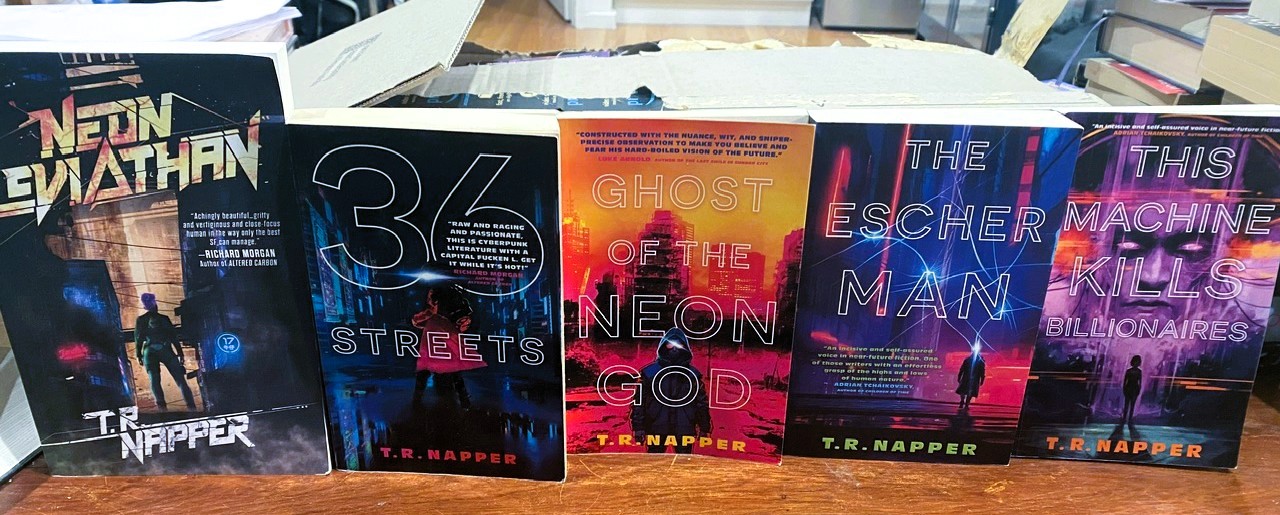
My latest release: This Machine Kills Billionaires
And click here for all my books.
(*It goes without saying that to you must write, as well. This is not a ‘rule’ as such as it is a statement of reality: writers write. Write as much as you can, as your schedule will allow. No excuses. Write).
Hello!
After a solid decade+ hiatus, I’m finally writing again and reading again (both in- and out-of-genre, at 20 books so far this year) and am also afflicted with your sickness haha, but am finding that the time that I am able to set aside for writing has been painfully slow, frequently writing little more than 500 words a week that I’m actually happy with. I’m sure that writing is a muscle which will only get stronger and more efficient with practice, but are there any big tips or practices that you have employed or heard about that you would recommend for improving throughput?
I’ve got significant outlining done and have a fairly strong visualization of the chapters I’m working on, but I find myself constantly trying to (likely foolishly) perfect each line as it comes out, rather than write more raw at the outset and refining later…
Help (and thank you for your writing and the blog post)!
Pablo
Thanks Pablo.
Writing is a muscle, and a discipline, and an obsession. I’ve written quote a lot of articles on this site that touch on this, but I’d say in your case just make it good, and keep moving with the story. I tend to be a perfectionist (though not as much as it seems you are), and so write slower than many of my peers. One thing I do every writing session is go back a page or two over the last thing I wrote, and edit – so my mind is attuned to the story flow, and so I’m happy with the quality of the prose – and then write from there.
But remember there is plenty of time for edits. I do multiple. You should aim for 1000 good words a week. Even at this pace, in two years you will have your novel.