Introduction
Discussion of Artificial Intelligence by the tech industry is equal parts dishonest and stupid. It is a discussion founded on the invidious lies of the snake oil salesman conjoined with the religious-like fervour of the fundamentalist.
Indeed, the cult of the techbro sees the singularity as god, the uploaded consciousness as the gift of eternal life, and the arrival of Artificial General Intelligence as ushering in heaven on earth: a post-scarcity era where every being gets everything they want, forever.
I won’t focus on the fanatical delusions of the industry here (though if you want a full accounting on this, read ‘God, Human, Animal, Machine’ by Megan O’Gieblyn. It’s brilliant). Rather, I’ll look at the oft-repeated lies and the self-serving greed of an industry that, at its core, seeks to destroy art. I’ll discuss the shallow and sterile world we are heading towards, and what we can do to fight back.
(click on the sun icon in the top right hand corner if you prefer to read black script on white)
The Will to Anthropomorphise
This dishonesty of the tech industry is particularly acute in the field of generative AI models, where obscurantist tech language tries mightily to anthropomorphise the machine. Where we are told, for example, that mistakes made by Large Language Models are ‘hallucinations’, or that chatbots can serve us as mentors, coaches, cheerleaders, counsellors, and even as romantic interests.
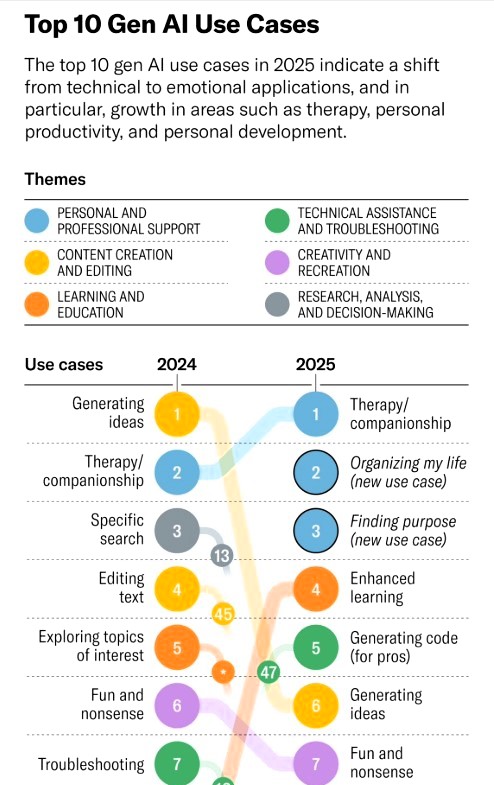 Let’s make this clear from the outset. A large language model has the same sentience as a toaster. It thinks about language about as much as a toaster does toast: that is, not at all. These are not coaches or counsellors, they are products. They are instruments of surveillance and data extraction for some of the most venal and amoral corporations on earth. The products don’t care about you, they don’t think about you. They don’t think about you because ‘they’ don’t exist as a consciousness.
When AI-driven search engines have a 60% error rate, they are not ‘hallucinating,’ they simply aren’t working. If you had a car that didn’t work 60% of the time, you’d take it back to the dealership. If you had doctor that got a diagnosis wrong 60% of the time, they’d be deregistered.
So why do they anthropomorphise? Cui bono? Who benefits? It is a question I approach in a recent novella, ‘The Hidden God’ (Asimov’s April/May), where one character says to the protagonist:
“Who benefits from insisting that the toaster is sentient, Izzy? Why, the man with the toaster factory.”
By imbuing sterile machines with human characteristics, they secure the profit margins of those machines. If we think that ChatGPT is actually our friend, then we will listen to it and we will trust it. It’s a way to turbocharge product loyalty. If we think the plagiarism engines that churn out poems or pictures have some level of sentience, then the industrial-scale theft of art required to fuel those engines becomes justified.
But the tech barons face no consequences for faulty products. Somehow, investors keep pouring money into these white elephants (as but one example, OpenAI is projecting losses of 14 billion dollars in 2026), and our legal and political systems move so slowly that it appears these companies are able to do anything they wish, with impunity.
And for us: we don’t even have the luxury of refusing these mediocre, unwanted, and unasked for products. We don’t because we live in an era where ‘AI’ is stuffed into every application, every browser, every appliance in our home, is jammed down our throats, whether we want it or not. The few choices we might have are shrinking every day, because the whole world is becoming a company town.
A Company World
A company town was (and still is) a place where the employees lived in accommodation owned by the company, and where all the storefronts and service providers were also owned by the company. It’s exploitative, as you’d imagine, a place where prices were manipulated and profit extracted from every facet of life.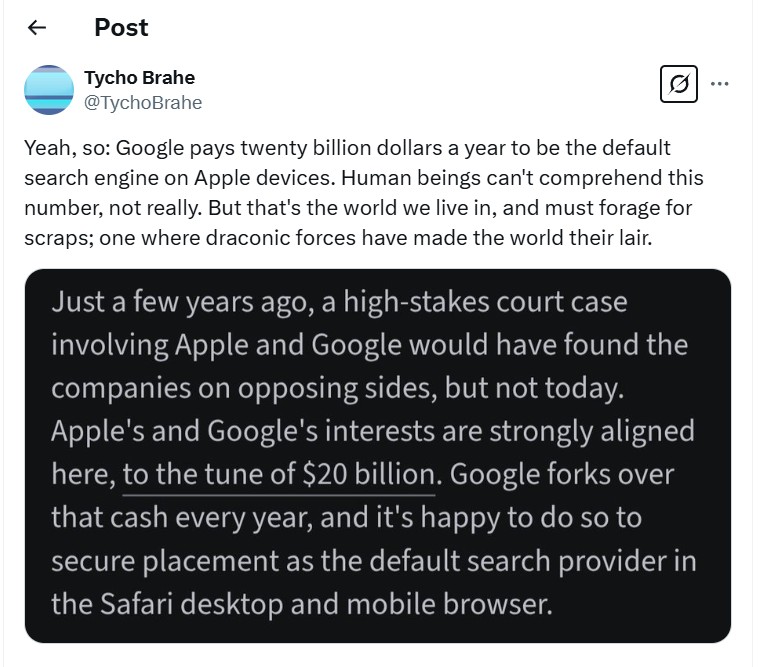
More and more, this has become the world we live in. In part through the myriad of products that have inserted themselves into our everyday life, as indispensable. Our smart phones track us 24/7, extracting our data. Awake and asleep, using the phone or not, it profiles us and knows us better than we know ourselves.
Big Brother has nothing on Apple. Big Brother was an amateur.
‘Draconic forces have made the world their lair’ (see pic, right) – it’s a good line, and written by a human. As it suggests, not only do our phones stalk us eternally, like a good company town they extract profit from us at every juncture – whether directly, from our wallet, or more insidiously, by strip mining our personal data.
 The more data they have the more control they may exert. They want us to be knowable. They want us to be dependent. Every waking moment, glued to our screen, anxiously doom-scrolling – this is the best mental state, from their perspective, because it makes us more malleable. They want us to be dumber, more supine, more predictable, because if we are all of these things, we are an easier sales target. Worse: we will accept their dominion over our inner lives.
This sounds like a cyberpunk dystopia, doesn’t it? The type of fiction I write, not the real world. But we live in a cyberpunk present, and we need to wake up.
The goal of the tech barons is to create a company world. And that includes in the arts. Nothing is scared to them, it is merely another potential source of profit. Privacy is not sacred, laws are made to be broken, and intellectual property is there to be stolen.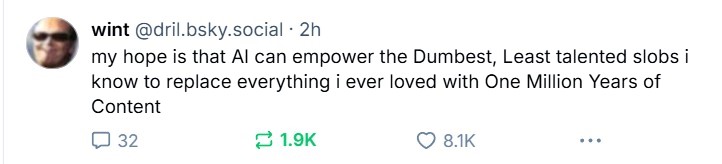
It was recently revealed, for example, that political bootlicker and habitual thief, Mark Zuckerberg, approved the heist of 7.5 million books, his company uploading them from a pirate website. Internal correspondence from the company has revealed their unwillingness to pay authors for their work, and the conscious choice to steal, instead.
To paraphrase F Scott Fitzgerald:
“Let me tell you about the very rich. They (and their functionaries) are not like you and me.”
Most normal people don’t steal, have a basic sense of decency, and aren’t much interested in the wholesale destruction of jobs and industries in service of a bottom line. But here’s the thing, billionaires are vastly more likely than the general population to be psychopaths. They are, objectively, not like you and me. Laws don’t matter to these people, morality doesn’t matter, and by god art does certainly not matter, in their quest for eternal profit and absolute control.
As Tim Hickson, author and YouTube personality, has said:
“The aim of these companies is to be all consuming. To create AIs which do everything, are everything, dominate every corner of human expression and monopolise it.”
This is the big picture – we are living in a Company Town. The apps and algorithms of the tech barons are colonising the connected world. This is their end game.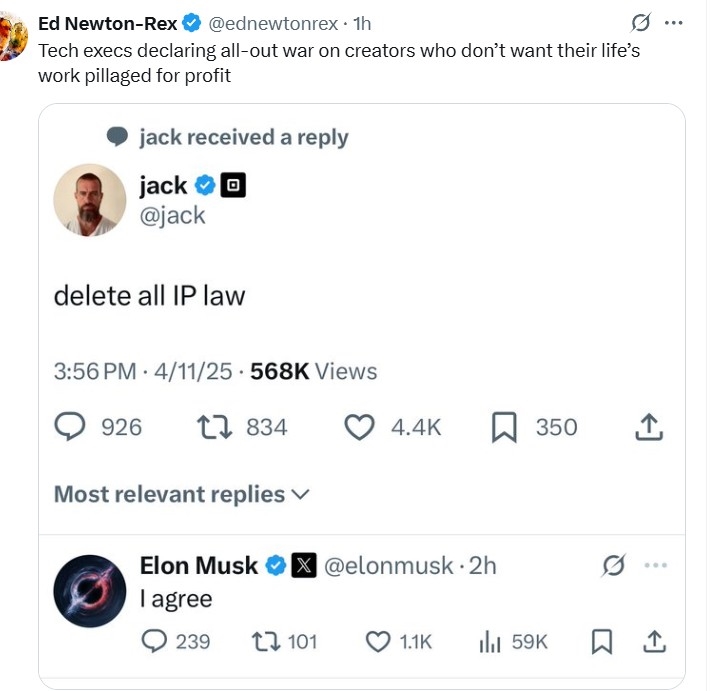
But to get there they more than just financial power, they need political and moral power. For the latter two, propaganda is part of the picture.
While I will continue to focus on my field, the arts, obviously their campaign extends beyond my industry. They come at us with a relentless barrage of facile arguments that rationalise the use of their odious products, arguments breathlessly repeated by the media – be that the legacy, social, or new media.
It’s the People, Stupid
Let us begin with the zombie arguments used by the techbros – and those credulous enough to listen to them – and why they are wrong.
At base, the reason is this: it’s the people, stupid.
Let’s begin here:
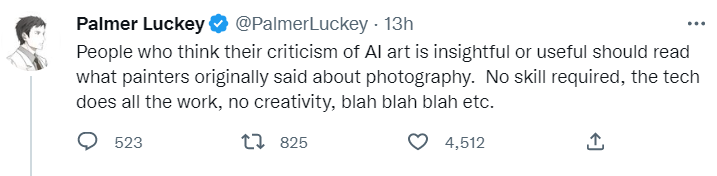
Palmer Luckey is the kind of useful idiot the tech industry loves. But, in this idiot’s defence, it is an argument I hear frequently. Hey, they used to have this same debate about photography, about how the machine was going to replace the paint brush, the true artist. So image generators like Midjourney are just the same, don’t you see?
Answer: it’s the people, stupid.
Yes, the camera did change visual art, and did render some professions less tenable. But there was a person behind the camera. And that person behind the camera was making human decisions about light, setting, contrast, composition, to the extent we now recognise photography as a distinct art form.
No human is behind the image generated by mid-journey, stupid. No thought.
Along similar lines, someone said to me once (a visual artist, no less), when I lamented the use of ChatGPT: you’d have been scared of the typewriter.
Answer: it’s the people, stupid.
A person sits behind a typewriter. A person writes those words.
A slightly more complex, and certainly one of the more insidious argument is this: but authors draw inspirations from multiple sources when they write a book, so a Large Language Model, using millions of works to generate story is just the same thing, actually.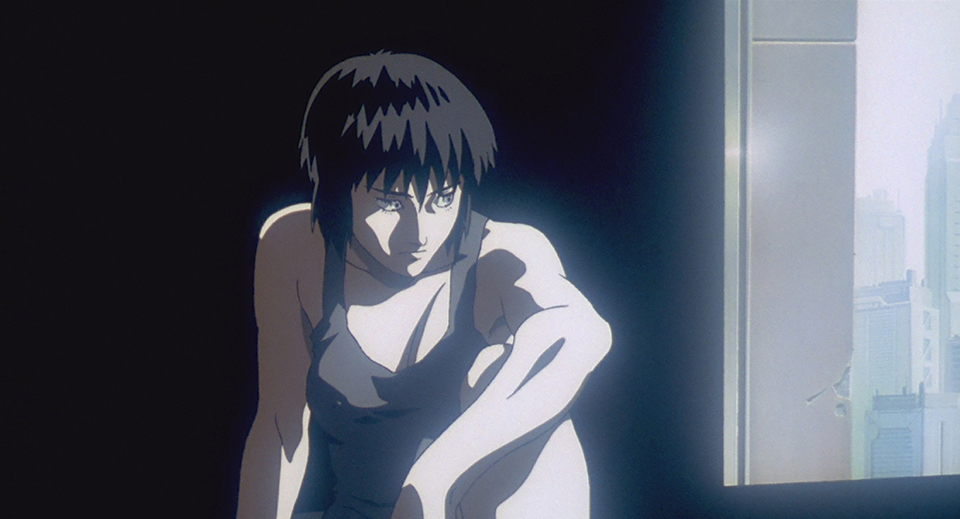
This is insidious because superficially there seems to be something to it, and even clever people (not wise, or intelligent, or thoughtful: merely clever) might be fooled.
Answer: it’s the people, stupid.
A golem made by techbros, fuelled by stolen art, mindlessly spitting out said works in reconstituted order, is not creating art. It has no life experience that it filters the art through, it has never contemplated or been influenced by one piece over another, it has never merged art with its own growth as a human being, and created something unique.
In short, there is no ghost in the shell. The soul is the spark, the special sauce that makes art art.
It’s the people, stupid.
Take Lincoln Michel:
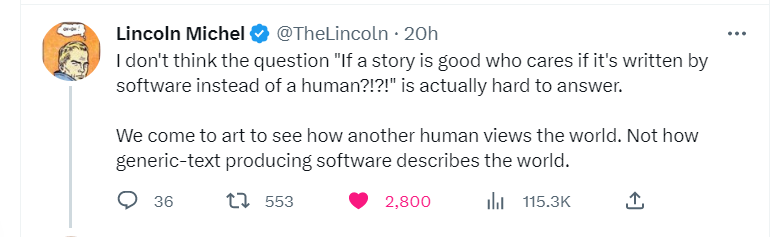
Or James Baldwin:
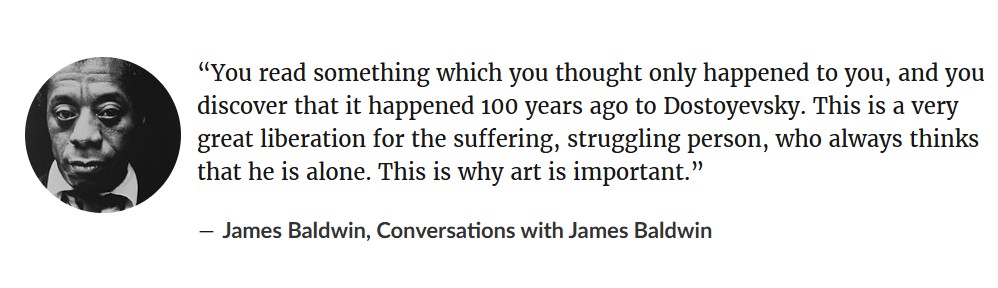
Or John Keating:
This brings us to the most important point. Above all else: to be creative is to be human, and to tell stories is part of the human experience.
Why Do We Need Human Art?
Beyond the financial reasons AI is so bad (artists need to eat), and the legal and ethical reasons (the art that fuels the AI machine was stolen, taken without our consent and without compensation), there is something deeper and more fundamental at play: the human soul.
As the brilliant Hayao Miyazaki (the creator of Studio Ghibli) said about AI.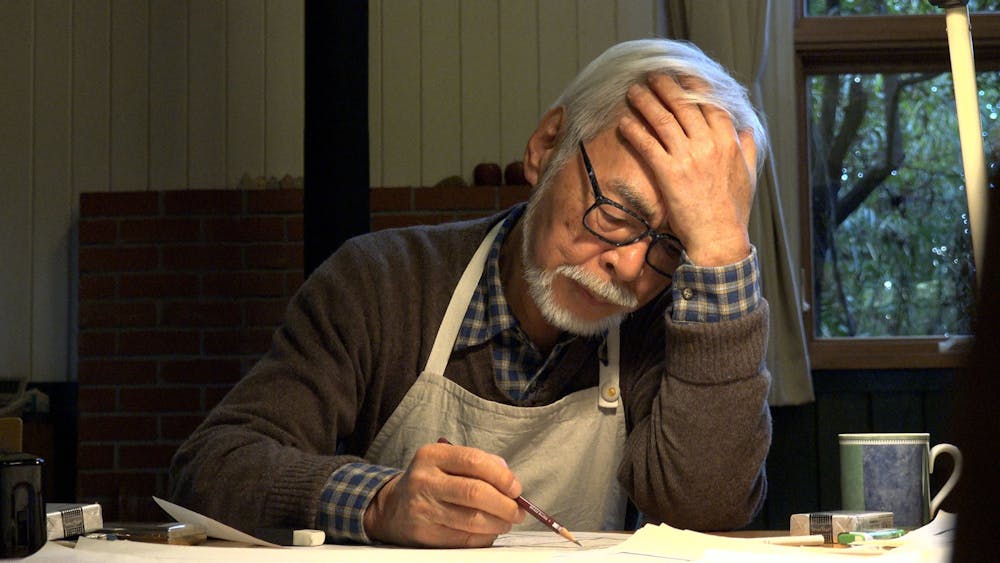
“I would never wish to incorporate this technology in my work at all . . . I feel like we are nearing the end of times. We humans have lost faith in ourselves.”
The Soul
Through my university I work on a program funded by the Australian Defence Force called ARRTS (Art for Recovery, Resilience, Teamwork and Skills). Twice a year, it draws in military personnel from across Australia who are suffering severe trauma. There are a handful of emergency service members as well (paramedics, firefighters).
The ADF flies them to my home town of Canberra, where for one month they do one thing and one thing only: create art. They can choose visual arts, music, or writing. The latter is where I come in.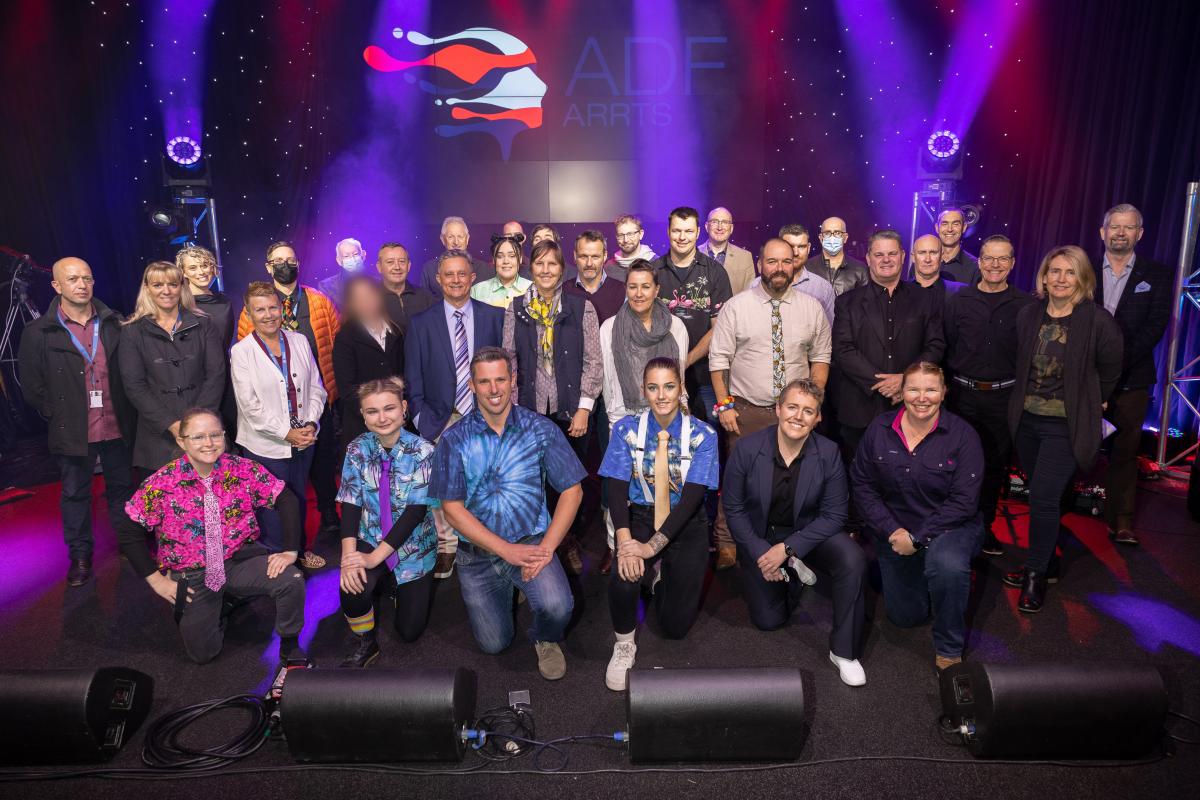
And let me tell you something remarkable: it works. The program lasts for a month, and by god it is an emotionally intense month, even for me, just as one of the mentors. The change in the participants over those four weeks is extraordinary. They are withdrawn when they begin, closed off, twitchy in some cases, tight empty smiles in others, struggling just with the bare necessities of day to day living.
By the end of the program they are different people. Or, to be more precise, the people they were before the trauma. One guy, on the first day, was asked his name. He had a stutter so severe it took him a minute to get it out. At the end of the second week we went to a poetry open mic night at a 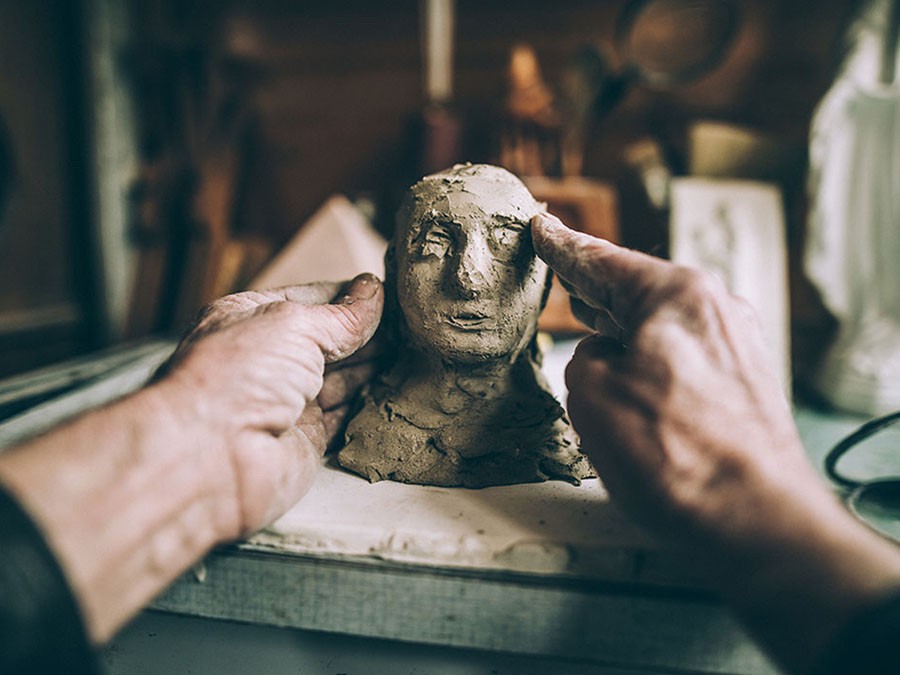 bohemian club in the city. This same guy got up, read out a poem he’d written, and performed it perfectly, every word. The crowd – who I’d feared would be a bunch of angry anti-war hippies (and in fairness, they probably were) – gave him the most sustained applause of any of the poets that evening. As he spoke of his desire to be free of his anguish, to return to the living world, live with nature on his farm, the atmosphere in the room was electric.
A second participant I’ll mention was a woman in the military, who had previously been a police officer. When she was in the force, colleagues would ask her to be the one to inform a family about the death of a loved one (a woman being better at this type of thing, according to her male co-workers). She wrote a one-page story about this, about how this duty had broken her, and I swear it was one of the most moving things I’d ever read. It still shakes me up, one year later. The thing is: she needed to tell this story, to exorcise her demons.
Just two examples. At the end of the month, the participants put on a showcase for friends and relatives, and for very senior officers of the military. It had music (written by the participants), a gallery of the visual arts produced, and readings from the group I worked with. It was by turns uplifting, heart-breaking, moving, revelatory. No one could question the benefits of the program, and I was astounded at the changes one month had brought.
So I ask you this: would they have experienced the same transformation of the spirit if had they instead turned up on day one and asked ChatGPT to write their poem? A program to write their music for them? Midjourney to create their art?
No. It’s the people. It’s the act. It’s the story. You see, I realised doing this work that we are a story telling species. It’s intrinsic to the human race.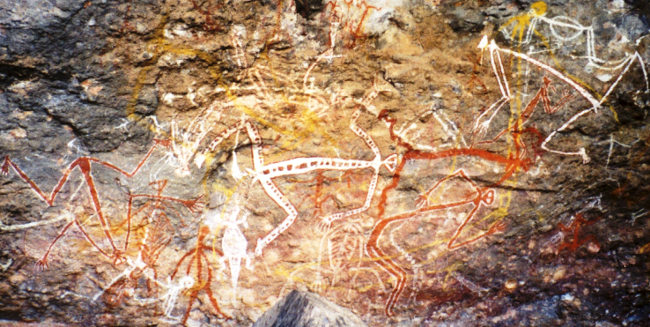
The oldest written story we have is the Epic of Gilgamesh (2100BC), the oldest pictorial story is a wall painting in Sulawesi that is 43,000 years old, telling the tale of a pig hunt. Fragments of Indigenous Australian art have been dated back as far as 60 thousand years, complete art as far back as 20 thousand. As long as we have existed we’ve felt compelled to tell stories.
In the modern era, the basic human need for art was laid bare during the pandemic. It’s a cliché now to say this, but it bears repeating: that crisis showed us what and who really matters – the delivery drivers, the nurses, the farmers, and so on – that’s who we needed for society to function. Not the influencers or hedge fund managers. But once we were locked down, and we had our basics, what then?
Art. Art sustained us. Music. Books. Film. Streaming. They kept us sane. They were vital. Without stories, life would have been unbearable.
We’re made of stories. The story of our childhood. Often recounted to us by our family, years later. The story of our country, what it means to be Australian, or Irish, or Nigerian, or American. All the founding myths and legends bound up in those stories. The films we watched and the books we read, those stories that seemed just to speak to us, as James Baldwin said.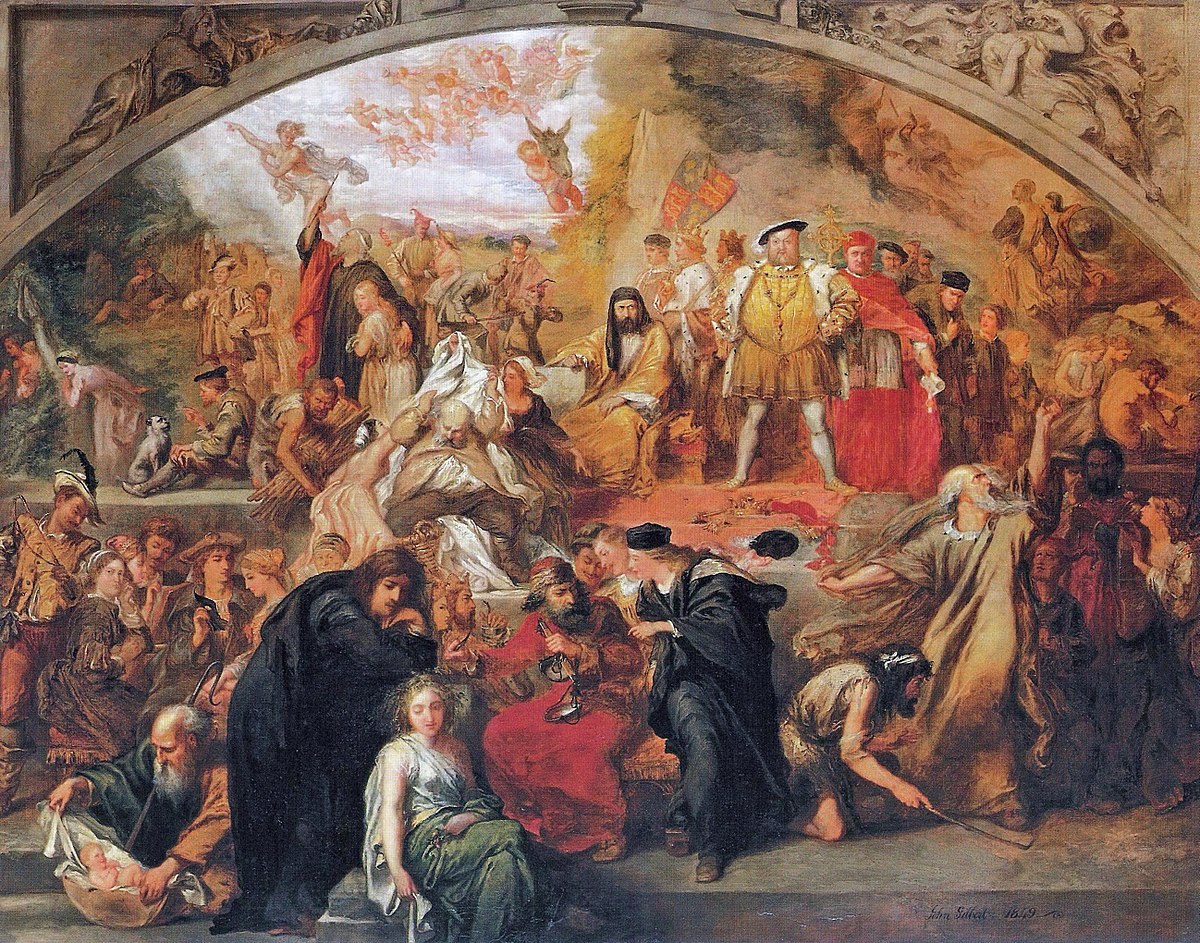
Whether or not we believe in them, the stories told by the world’s great religions have shaped our lives. And Shakespeare, in the West in particular, enriched our language and therefore the way we conceive of the world – green with envy, all the glitters is not gold, wild goose chase, to thy own self be true, swagger, heart of gold – all these and hundreds more came from the Bard. Stories shape us, create us, sustain us. The universe can be cruel and random and indifferent, but stories help us find meaning in the darkness.
We are a storytelling species, which means at core we are a creative species.
To be creative is to be human and you need to understand this point: the techbros and their billionaire liege lords want to take this away. They want to replace our creativity with their products. They want us to pay them to replace something difficult and vital – which is the human act of creation – with something easy and impersonal and disposable.
They want us to be less. I spoke of anthropomorphising the machine, but there is the other half of this: the artifactualising of the human. They want us to be less than we are. Less creative and thoughtful, less capable of doing and thinking for ourselves.
I saved the following quote from @stilloranged on Twitter, from a few months back. It’s truer than ever:
“When people are unable to think for themselves, they are unable to resist conformity or to rebel. They become the machines. And eventually, there will be no new spark of human originality left for you to harvest from people and monetize. It will all have been spent.”
What is to be done?
It seems hopeless, to resist the march of what they call technological progress. But technology is not the hand of god, it is not divine providence. Technology is made and owned by people, and the way it is used is an expression of their will. Yes, they are powerful, the oligarchs. But many of us still live in democracies, and all of us live in communities and societies, and they are run by people. Hope is not lost, and if you reflect for a moment on how detested the oligarchs are – Musk surely is the most hated man on the Earth right now – nothing is foreordained. As Ursula le Guin said in her famous National Book Award speech:
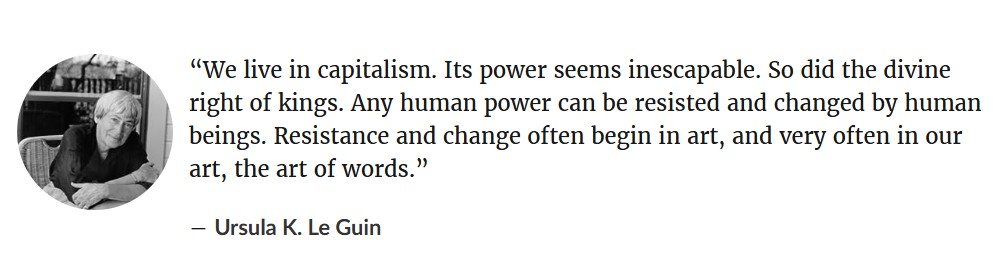
But we don’t even have to overthrow capitalism to get rid of the oligarchs, to safeguard art. We just have to stop these cunts from stealing.
Broadly, we can respond in four ways to the ongoing theft of our art by tech companies (and the AI slop they churn out): legally, politically, individually, and culturally.
Legally
For artists, you should include anti-AI clauses in your publishing contracts from here on out. I have in the past (specifying a human artist for the cover), and more recently have adopted the clauses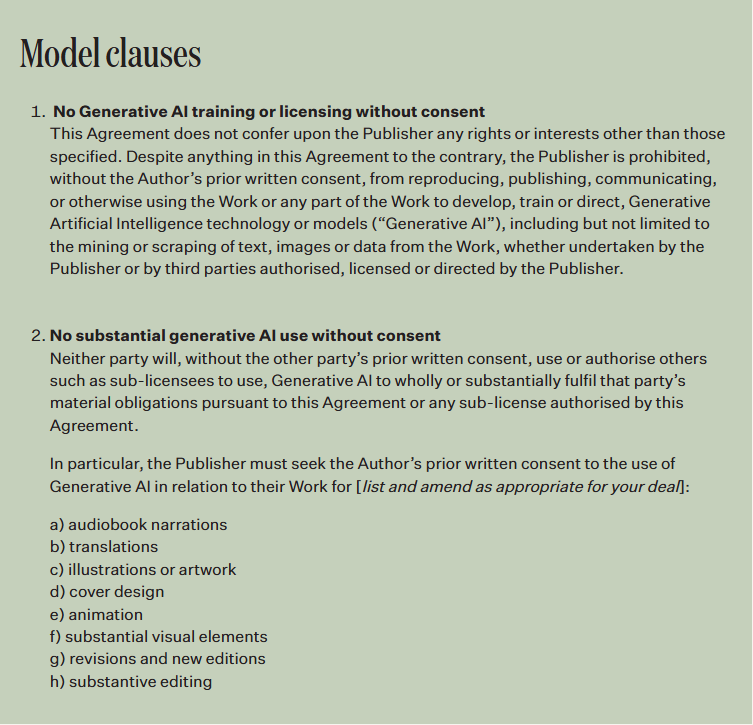 proposed by the Australian Society of Authors. The link is here. It’s an Australian site yes, but the clauses are applicable to any publishing contract.
We need laws. Books made, or assisted, by AI must have this disclosed on the cover. Intellectual Property must be respected, and I fervently hope the various cases against the art robber barons succeed. Legislatures move slowly, but they still move, and where we can, we must place pressure on them. Which leads us to the next point.
Politically
As a first instance, if your writing has been stolen, the Author’s Guild of America has a page explaining the actions you can take. For example, there is a simple template you can one-click here to send a letter to Zuckerberg, to tell that quisling thief he doesn’t have permission to use your work. The various authors guilds I’ve looked at (US, UK, Oz) have steps you can take, like writing letters to politicians, sending open letters, and donating to lobbying efforts.
You don’t need to be an artist to do this. Anyone who loves books can write letters and donate to the cause.
Personally
Little things every day. Minimise the apps you use and if you can bear it, delete your apps altogether. Spend a day without a device (I do this one day a week), and you will be stunned at how productive that day is. Do that once a week. Twice. More. Opt out of everything you can, agree to nothing.
Never buy a book that has had AI used in any part of its production (cover art, content). Don’t use ChatGPT or Midjourney or any other of the models whose fuel is stolen art. Don’t train them and don’t patronise them. Refuse, reject.
Culturally
Artistic communities must stand firm against the creeping insinuation of AI. No mealy-mouthed exceptions, no equivocation. This means that awards committees make clear that any works made or assisted by AI will be ineligible. It means professional organisations must kick out any member who uses AI in their work. It means these types of bodies state clearly in their constitutions that the content-creating crowd of talentless charlatans can go and politely fuck off.
I will never support a writer (blurbs, launches, retweets, anything), who uses AI in their work. None of us should. Ostracising those who use LLMs may seem harsh, but this fight is existential.
As a culture we must explain why we have made this stand: it is unethical, illegal, and dehumanising to use these golems. We must draw a line.
Conclusion
The tech industry, they say of themselves, likes to move fast and break things. This includes the law. This includes the tenets of basic human decency. Once their motto was ‘don’t be evil’. But that motto was dropped long ago. Because how can you believe in such a thing, when you want to rule the world?
Art has no such desires. It inspires, it entertains, it provokes and it reveals. It tries and it fails. It changes lives, and minds, and shakes the world. It falters and it second-guesses and it fades away. It loves and it hates and above all it reaches.
Art reaches for the ineffable. It tries to tell the impossible story: the story of ourselves.
We are a story-telling species and so art is the language of the human race.
That’s all. That’s all we’re fighting for.